The Art of Line and Shadow: Ancient Indian Painting Techniques
The Eloquence of the Line
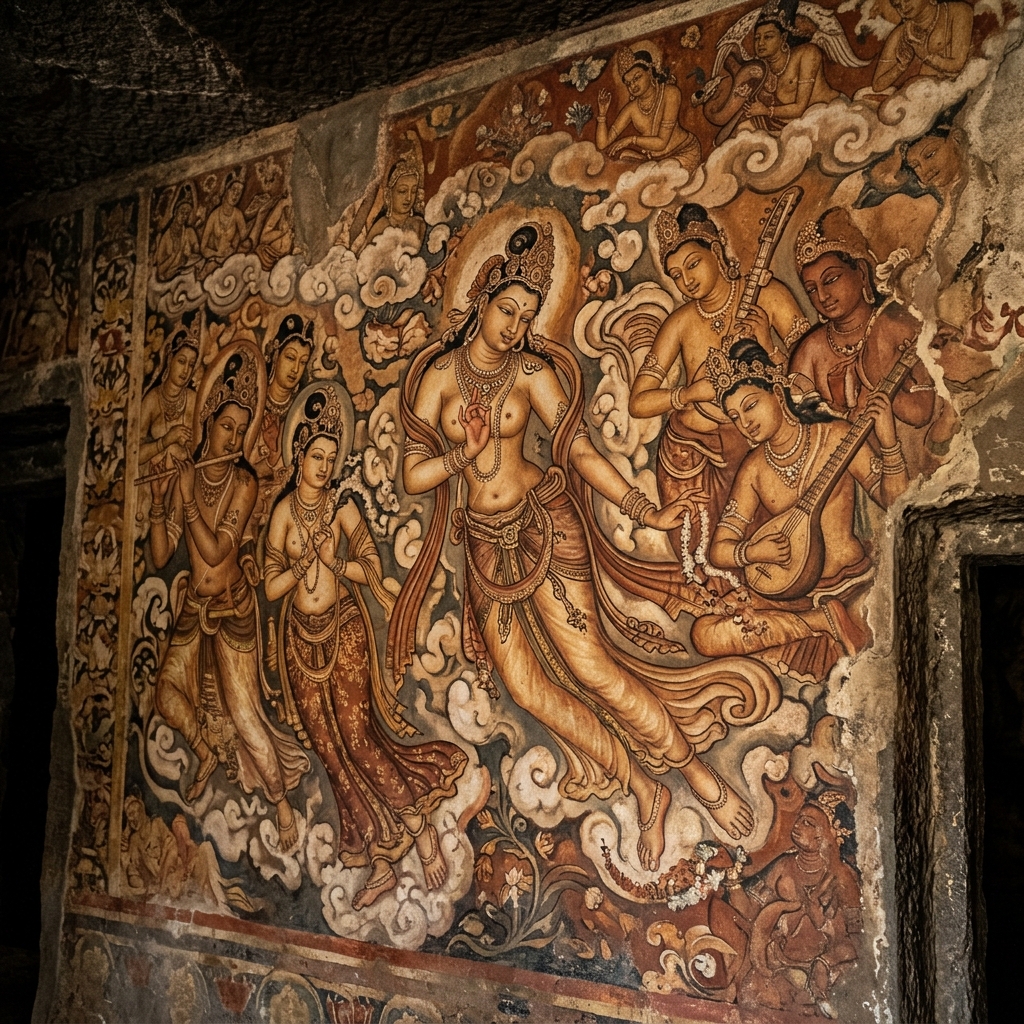
Classical Indian art is, at its core, an art of the line. While Western classical art often relies on heavy shading (chiaroscuro) to create the illusion of three-dimensional depth, the ancient masters of Ajanta achieved an extraordinary sense of volume, weight, and emotion primarily through the sweeping grace, thickness, and direction of their outlines. This unique style created a fluid, rhythmic world where every figure seems to breathe and move.
The Living Outline: Red Ochre and Lampblack
The process of painting at Ajanta was highly disciplined. Once the smooth lime plaster surface was dry, the master artist sketched the initial composition using a light red clay pigment (Geru). This line was freehand, incredibly confident, and fluid. Once the colors were filled in, the artist returned with a fine brush made of animal hair to draw the final outline using deep red ochre or carbon lampblack. This final line was not uniform; it swelled and thinned dynamically to suggest the curve of a cheek, the soft weight of a limb, or the delicate fold of a garment. It was a line that did not just define boundaries—it suggested life.
Visual Modeling Without Heavy Shading
To give the painted figures a realistic, rounded volume, the artists used subtle techniques of color gradation rather than harsh shadows:
- Convex Shading: The artists painted the center of limbs and faces with lighter, brighter color tones, while gradually darkening the colors as they approached the outlines. This created a gentle, spherical swelling that made figures pop off the flat wall.
- Multiple Perspectives: Rather than using a single, rigid vanishing point, Ajanta paintings utilize multiple perspective angles within the same composition. A king might be viewed from the front, while the courtiers are sketched from a three-quarters angle, creating a dynamic, immersive experience for the viewer.
Reinstating the Ancient Contours
Centuries of moisture, flaking plaster, and smoke have broken these beautiful ancient outlines, leaving many murals as fragmented shapes. Shree M.R. Pimpare devoted decades to studying the underlying anatomy and geometric principles of these drawings. His canvas reconstructions painstakingly reunite these broken contours, restoring the original flow, rhythm, and structural elegance of the classical lines, allowing us to study the exact techniques of these ancient masters.