
Patrons of the Golden Age: The Vakataka Dynasty’s Legacy
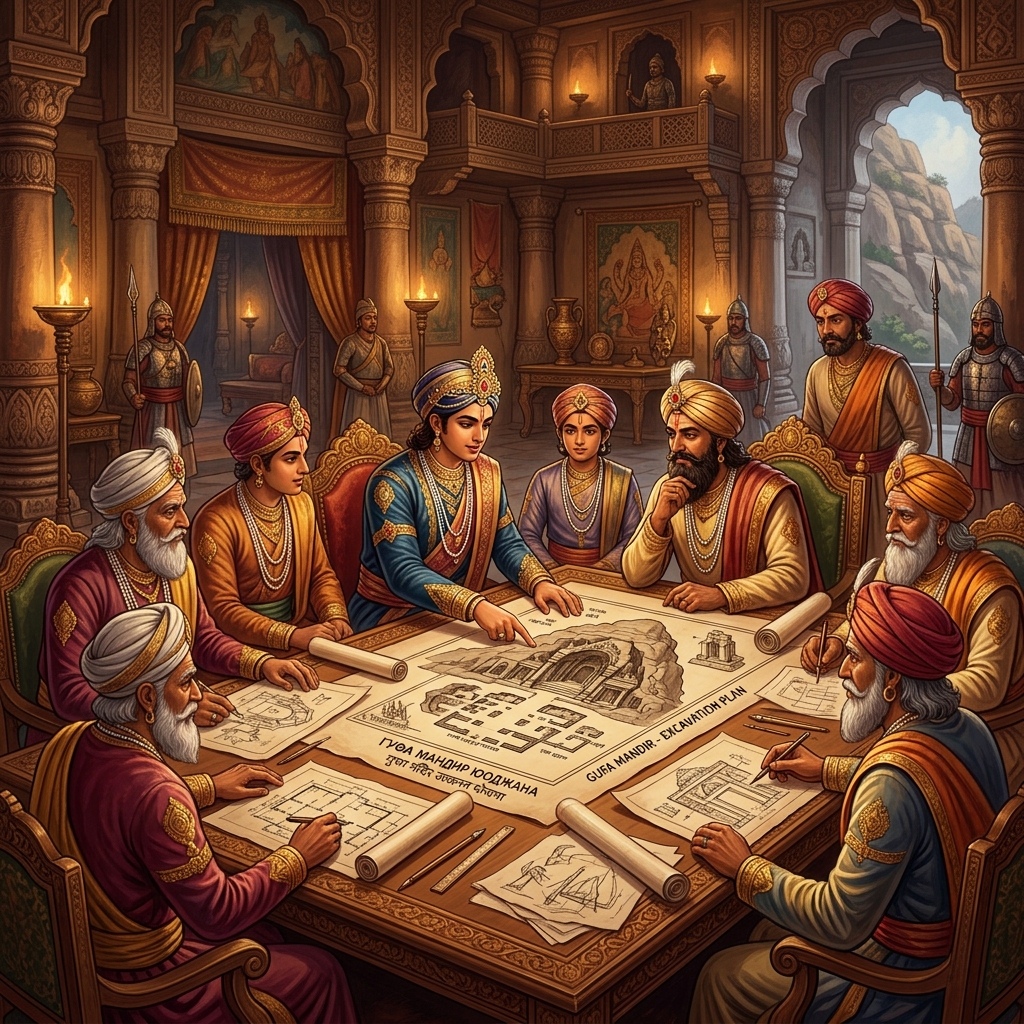
The Royal Funding Behind the Masterpieces
Who paid for the carving of these massive monolithic temples and the painting of these miles of gorgeous murals? The creation of the Ajanta Caves was not a spontaneous project; it required astronomical financial wealth, complex logistics, and stable political conditions. This golden era of artistic creation was made possible by the powerful **Vakataka Dynasty**, who ruled the Deccan region during the 4th and 5th centuries AD.
Emperor Harishena: The Visionary Ruler
While the earliest caves at Ajanta date back to the 2nd century BC, the vast majority of the spectacular painted caves—including Caves 1, 2, 16, 17, and 26—were excavated during a short, intense period between 460 and 480 AD. This rapid explosion of art was fueled by **Emperor Harishena** (reigned c. 460–477 AD). Harishena was a brilliant administrator and military leader who united the Deccan, establishing a secure empire that fostered international trade, literature, and religious tolerance.
Ministers, Feudatory Kings, and Monks
The inscriptions carved on the cave walls reveal that the donors were the most powerful elites of Harishena’s court:
- Cave 16: Excavated and donated by *Varahadeva*, the highly influential Prime Minister of Emperor Harishena, who described the cave as a "dwelling fit for a king of monks."
- Cave 17: Gifted by *Upendragupta*, the wealthy feudatory king of the local region, who spent fortunes to carve a monastery filled with gorgeous paintings of the Jataka tales.
- Cave 26: Donated by the scholarly monk *Buddhabhadra*, who secured funding from the royal court, stating that a monument built on this sacred mountain would ensure eternal merit.
A Cosmopolitan Cultural Center
Under Vakataka patronage, Ajanta became a thriving cosmopolitan university and monastery. The empire's close ties with the Gupta Dynasty to the north created a fertile environment where artistic styles, architectural manuals, and Buddhist philosophies merged. This royal support attracted the finest master painters, stone carvers, and gem-cutters from across India. Shree Pimpare's reconstructions celebrate this historical era, capturing the royal court assemblies and grand historical figures with stunning clarity and rich, aristocratic color palettes.