
The Science of Ajanta's Natural Pigments
The Master Chemistry of Ancient Indian Artists
How did paintings created over 2,000 years ago in dark, humid caves survive to the modern era with their colors still vibrant and alive? The secret lies in a remarkable combination of geology, chemistry, and meticulous craftsmanship. The ancient artists of Ajanta were not just visionary draftsmen; they were master material scientists who possessed a deep understanding of natural minerals and binders.
The Earthy Palette: Sourcing from Basalt and Clay
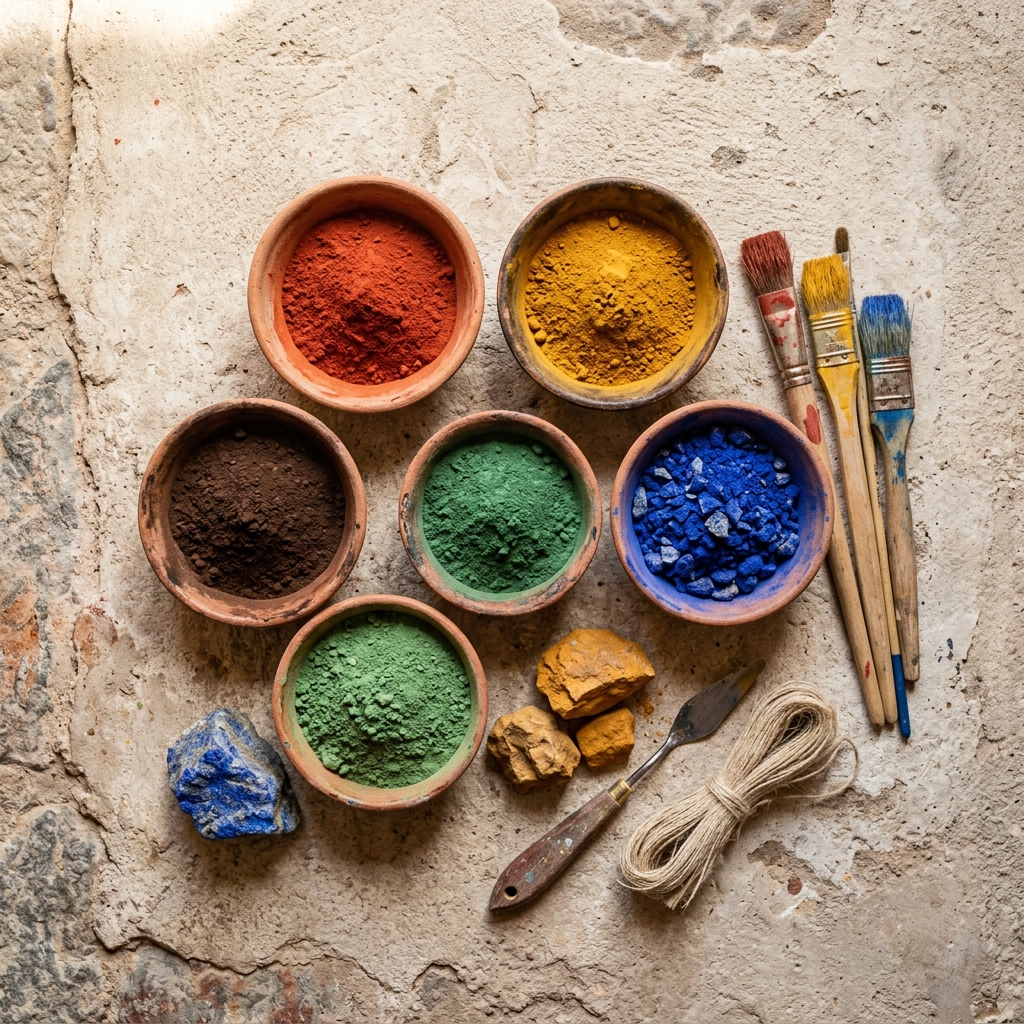
Except for a few imported minerals, almost the entire color palette of Ajanta was sourced locally from the surrounding volcanic Deccan basalt hills. The artists gathered minerals from the soil and ground them into fine powders:
- Red and Yellow Ochre (Gera): These iron-oxide-rich clays provided the warm, earthy foundation of the murals, used for skin tones, royal drapery, and architectural backgrounds.
- Green earth (Glauconite): Sourced from local volcanic veins, this mineral gave the paintings their beautiful olive-green hues, perfect for rendering foliage, forests, and celestial halos.
- Lime (Chuna): Used for the brilliant white highlights, eyes, pearls, and as the reflective ground layer applied over the mud plaster.
- Lampblack (Kajal): Made by collecting soot from burning oil lamps, this carbon-rich black was used for the expressive, flowing outlines of eyes, hair, and borders.
The Imported Luxury: Lapis Lazuli
The only color that could not be sourced locally was the brilliant, deep blue. This was made from grinding Lapis Lazuli, a semi-precious stone that had to be imported all the way from the Badakhshan mines of modern-day Afghanistan. Because of its high cost and rarity, blue was used sparingly in Ajanta. It was reserved for the most sacred figures, royal jewelry, and celestial elements, symbolizing the infinite sky and divine wisdom.
The Fresco-Secco Technique
The paintings of Ajanta are often referred to as "frescoes," but technically they are fresco-secco (paintings on dry plaster). First, a thick, coarse layer of clay, sand, cow dung, and rice husks was applied directly onto the rough, chiselled rock walls. Once this base dried, a thin, smooth wash of fine lime plaster was spread over it. The artists then painted on this dry surface using pigments mixed with a organic binder, typically animal glue or gum Arabic. This binder locked the mineral particles into the porous lime structure, creating an incredibly durable bond that has withstood centuries of environmental stress. Shree Pimpare's reconstructions honor this ancient chemical legacy by using premium pigments to capture the exact, deep color values of the original murals.